Episode Transcript
[00:00:12] Hello, friend. Skip here. And I want to talk about something today that has been.
[00:00:19] I don't know if bugging me is the right word, but I did something and realized right in the middle of it that it's the wrong thing to do.
[00:00:29] And it started me down this path of why we do this.
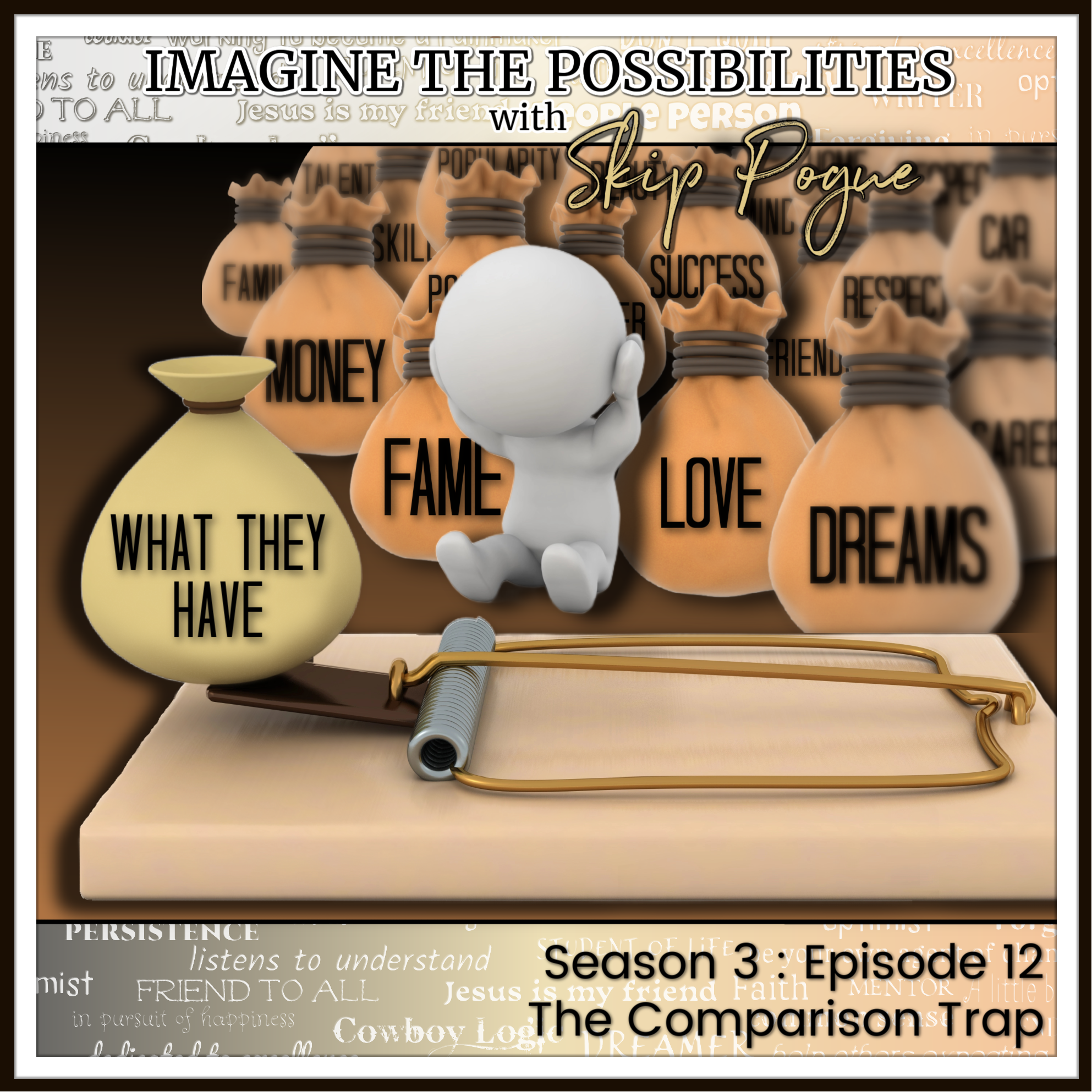
[00:00:34] The title of the podcast I came up with is the Comparison Trap. We shouldn't compare ourselves to other people, but sometimes I think it's in our DNA, but it's a bad thing to do.
[00:00:48] When I caught myself, I was looking at my numbers and someone else's numbers as far as likes and all that, and they had a lot more likes and a lot more this, a lot more of that. And I realized I'm like, I'm not doing a good job. If I was doing a good job, I'd have that same numbers or maybe better numbers. So I sat and really got to thinking about it. And one thing I realized is they had been doing what I'm doing for a long time, a lot longer than I've been a podcaster.
[00:01:21] Therefore, the comparison was not valid.
[00:01:24] But in my mind, I thought it was. Comparison is one of those things that sneaks in quietly, and that's what happened to me. I didn't sit down at the computer intentionally to go do that.
[00:01:35] I was just working on a podcast and something went off. I was on. I don't remember what I was on at the time, but I went and looked. I was like, wonder how I compare to Joe? We'll just say, joe. Wonder how I compare to Joe?
[00:01:51] Well, when I looked, I was like, hmm, we're not even close. He's so far ahead of me, I don't know if I would ever catch him. No matter what I did, that was starting immediately, almost to steal my joy.
[00:02:07] It was a distraction.
[00:02:09] It stole my gratitude. It put a lot of pressure on me.
[00:02:14] Even though from the first podcast to this podcast, I. I have grown in my mind tremendously. I think the podcasts are better. It's easier for me. Not that it's still not a struggle sometimes, but it's easier for me to record a podcast, have more fun with it.
[00:02:33] It's not like it's a job that I've got to do. It's just.
[00:02:38] It's almost relaxing now. So why did I do it? Why did I look at them instead of me? Why was my focus on them instead of me?
[00:02:49] When we compare like that, it's like external scorekeeping. This is not a baseball game or a football game or whatever. It is it's life. But it's not one of those things that we ought to be keeping score in, or the only things it was doing, as far as I was concerned, was it was putting a lot of unnecessary pressure on me to perform better.
[00:03:13] And all the progress that I'd made, it made that feel small.
[00:03:21] It stole my joy.
[00:03:23] It became a distraction from the purpose. When I started this podcast, when I started it and up through, let's say, five days ago, I had one mission, I guess one thing I wanted to accomplish.
[00:03:41] Every podcast I did.
[00:03:44] And I said it in the very first one I did.
[00:03:47] I wanted to help one person.
[00:03:51] Ten people listened to it, 100 people or a thousand people. But out of whatever number it was, I wanted to feel like I had helped one person by looking at these numbers and comparing myself and changing what I was doing into keeping score, I forgot what my mission was. I only looked at the raw numbers. That was never my mission. My mission was to help one person. And I truly believe that each and every podcast has helped one person.
[00:04:24] There's drivers for this comparison, though, that happen all the time. We have this social media culture.
[00:04:32] You know, we post something on Facebook and somebody else posts something, a third person posts something, and we look at how many likes they've got. Why did they get more likes than I got? Mine's got a picture, really good picture with it. It's got. Says the right stuff, but yet theirs is silly.
[00:04:51] Well, it's silly to me. It wasn't silly to them, and obviously it's not silly to other people because they're getting more likes than I am.
[00:04:59] So I got this feeling I was behind everybody else. I needed validation for what I was doing.
[00:05:07] The numbers are not the place to go get the validation.
[00:05:10] All that does, and all it did for me was demonstrate that I had a level of insecurity that I didn't need to have.
[00:05:19] Sometimes we compare the stuff we see to real life when it's not meant to be that way. The person that wrote it or posted the picture or whatever had no intention of it being compared compared to real life.
[00:05:32] So we've got to be conscious of all that if we're going to measure ourselves, which I think is important for a podcaster, any type of creator, and actually everybody is measure our progress, not our popularity, because the likes and the thumbs up and all these different things are really, how popular is that, what you put on Facebook? Let's just use Facebook as an example. They all demonstrate popularity, not necessarily progress. If I compare where I am Today, in doing podcasts to where I was when I first started, I've grown by leaps and bounds. When I first started, I was uncomfortable behind a microphone.
[00:06:24] I was uncomfortable when I listened to the podcast. And over the three seasons that I've done, I'm comfortable.
[00:06:35] It's not a struggle. I enjoy it.
[00:06:38] We need to focus on purpose, not on what position we're in. We need to be able to celebrate others accomplishments without diminishing our own.
[00:06:53] Let's say we figure out we can stop comparing.
[00:06:58] We take a stand, we drive a stick in the ground, draw a line in the sand, however you want to say it, what happens? We feel free.
[00:07:08] Maybe for the first time since we started doing whatever it is we're trying to measure against somebody else.
[00:07:14] We feel joy, our energy returns. We have more gratitude.
[00:07:20] In my case, we have more confidence.
[00:07:23] And all of that allows us to reconnect with the purpose that we started. Whatever it is to begin with. In my case, it allows me to reconnect with the purpose I started this podcast for. I've talked through this thing about podcasting or about doing some Internet, but let's talk a little real life.
[00:07:47] What happens?
[00:07:49] Let's say we're in the corporate world and we're working really hard to accomplish something and we feel like we're on the precipitous of doing that when all of a sudden the job opening we've been working toward gets filled with somebody else by somebody. The manager selected them over you.
[00:08:12] Now, they may have been much more qualified, but you're not going to look at it. You're not going to look at their qualifications or anything else. You're going to try to find the flaws in the person.
[00:08:23] You're going to go, you're going to look at it from a negative standpoint. Why did they.
[00:08:28] They can't do this as well as I can. They don't know anything about spreadsheets. They don't know anything about word, how to write, how to talk, how to do anything.
[00:08:37] They've never spoken before, company presidents, they've never even run a meeting.
[00:08:43] Well, how do you know that?
[00:08:45] Or is that just your opinion? The reason I asked the questions is because I had that exact scenario happen.
[00:08:53] And I didn't understand it until I had a relatively short conversation with God and he explained it to me. And once I did that, I realized he was right.
[00:09:07] I was comparing apples to oranges. I was not doing what I was supposed to be doing.
[00:09:14] I had literally froze. As far as moving forward, we have to look at Comparison for what it really is.
[00:09:23] It's external. Goalkeeper. Now we keep scoring. A baseball game, a football game, a hockey game, a rodeo, whatever it is has some scores associated with it.
[00:09:36] Somebody gives you a score or you hit a home run, you get one, you know, you get one run and you're beating the other team by one run, one to nothing.
[00:09:47] It's okay to score, keep in those things. But it's not okay when it comes to comparisons and we're trying to keep score.
[00:09:56] The only comparison we ought to be making is are we doing a better job today?
[00:10:03] Are we accomplishing more today?
[00:10:06] Are we moving forward like we want to? Today versus yesterday. That's the only comparison.
[00:10:15] Not them against me, but me against me over a 24 hour period.
[00:10:22] That's all.
[00:10:23] Because if we compare ourselves to other people, it's like keeping score.
[00:10:30] It distorts reality because we may be compared to ourselves the day before or compared to our journey, we may be doing a great job.
[00:10:42] But if we compare it to other people, we might not be doing what they expect us to do or we can't emulate someone else.
[00:10:53] But here's the thing.
[00:10:56] When we compare ourselves to other people, it steals our joy.
[00:11:01] When we compare ourselves to other people, it oftentimes becomes a distraction. We're no longer moving toward our purpose. We're distracted by the comparison.
[00:11:13] And sometimes it'll block gratitude.
[00:11:16] One of the big things is it will create more pressure on us. We see somebody making high numbers and we're making, let's say we're doing middle of the road, we're doing okay.
[00:11:26] But now we've got all this pressure to move up and move up quickly. We don't set the goal that we're okay.
[00:11:34] We're going to be at the same level John is in a week when maybe it's okay. If you wanted to set a goal and say we're going to be at the same level John is today, in a year.
[00:11:46] But we have to remember in that year John's going to probably move up some. Now, he may not be 100 points or 100% ahead of us. He may only be 50, which means we're getting better, but it's still the same thing.
[00:12:01] And if we're making progress, it makes that progress feel small.
[00:12:08] Why do we compare things? To start with, we all probably have a social media culture. We have these thoughts about we write something on social media and we want to know how it's doing. Are we getting the same number of likes that Fred's getting or are we not getting as many. Why is that? Comparison impacts us because it increases our insecurities.
[00:12:33] Another place that comparisons come from is our desire to belong to some group or simply to be validated in what we're doing.
[00:12:44] It can also make us feel like we're falling behind compared to everybody else. All of those are bad things. They affect our ability to move forward.
[00:12:55] Now I believe there are better ways to see ourselves always look forward to where we're going, not sideways where we lose our focus on our purpose and our journey.
[00:13:09] We need to measure progress and not popularity. Because when you think about it, most of the things we see on social platforms is more of a popularity contest. It has nothing to do with our long term progress to become whoever and whatever we want to be. We need to focus on our purpose, not the position we're in. And we need to understand and this is important.
[00:13:38] This is part of kindness, empathy and a lot of other things, that it's okay to celebrate others successes and that by doing so it doesn't diminish us, it doesn't change who we are, it doesn't make us small.
[00:13:57] And that's also important.
[00:13:59] What happens if we stop comparing ourselves to other people?
[00:14:05] Probably the two things that will happen the quickest are we'll start feeling a new level of freedom and an increased level of joy.
[00:14:18] Then we'll see our energy return, we'll be more grateful and a big thing. Our confidence will get better.
[00:14:27] We'll see that.
[00:14:28] We won't feel like we're small, we'll feel like we're real moving forward and we'll reconnect with our purpose. Why are we doing something? What's our purpose? I look at the numbers, I'll rephrase that. I looked at the numbers for this podcast and I thought, well, that's okay, but it's not as good as I thought it should be.
[00:14:54] And all this happened about four or five days ago.
[00:14:59] And then it dawned on me.
[00:15:02] The purpose of this podcast was never about the numbers. When I started this podcast, I would call it a mission statement because it's more one line. But the one thing I said I wanted to accomplish was the one and only thing I said I wanted to accomplish. When I did a podcast and it was published. If it helped one person grow or move forward or have a better day or whatever positive thing came out of the podcast for one person, I was successful. And I think that applies to a lot of things. If we help one person do something or we help ourselves get better, make our journey easier or whatever, but one person, then we're successful.
[00:15:55] We all need to be encouragers. We need to show kindness. We need to love people without conditions.
[00:16:03] If we do all those things, then we're doing the right thing.
[00:16:07] And there's no comparison in those. There's no numbers in them. They're real life versus running in a popularity contest.
[00:16:17] So I think that we just need to think about when we catch ourselves, because like I said, I didn't sit down the day this happened to look up numbers. I sat down and I fell into the comparison trap. All of a sudden, something trigger me, I need to look at my numbers and see what kind of numbers I've got. And I did that, but then I didn't stop there.
[00:16:44] That was bad enough.
[00:16:47] I don't think it's bad to track your own growth and your own journey per se, as long as you don't do what I did. I took the second step. I should have stayed at the first step, but I took the second step, which was, well, wonder how that compares to Joe and Fred and Bob and Bill.
[00:17:06] One went and looked at Joe, Fred, Bob and Bill's numbers and all of them were higher than mine.
[00:17:10] I'm like, well, I must not be doing a good job. I don't know why I'm even doing this.
[00:17:16] Didn't think about the fact I enjoy it. I didn't think about the fact that my mission was to help one person.
[00:17:24] I hope every time I record a podcast, I hope everybody listens to it.
[00:17:29] Everybody that listens to it gets something. They get a takeaway, they get something emotional, they get a boost in energy or whatever, that I've done something not only to help one person, but help everybody. But the mission was only to help one person and remains to only help one person. Not that I wouldn't like to help 100 or a thousand, but one person.
[00:17:53] And I think we all have got to do that. I think we have to tread lightly when it comes to looking at ourselves and then making that error to compare ourselves to other people.
[00:18:09] Number one, when we do that, we don't know what that person's experience level is. We only see them on whatever media we're looking at, whatever social program we're on. We only see them there. We don't know them personally, we have no idea what their background is or anything else. But it's valid to compare apples and oranges. No, it's not.
[00:18:32] I guess the net of this whole thing is that to keep our emotional footing and our purpose and our journey all Intact.
[00:18:43] When we catch ourselves about to compare or even comparing ourselves to other people, we need to stop.
[00:18:51] We need to stop immediately. Now, this is funny. And I haven't done it, and I've actually surprised myself by not doing it.
[00:18:59] A year ago, I would have probably started up Excel. Everybody knows me thinks I use Excel for a lot of stuff, but I would have probably started up Excel, picked nine other podcasters and put myself in the first row and. And put the other nine in the next nine rows across and then thought up things. I wanted to compare how many likes they got, how many followers do they have, how many of this, how many of that? And I had this spreadsheet that would ultimately become the most depressing thing that I think of.
[00:19:33] So don't do those things. Don't compare yourselves to other people.
[00:19:38] Compare yourselves to what you were doing or how you were doing yesterday. And that's all.
[00:19:46] It's all that simple.
[00:19:48] Just look at yourself. Don't look at what others are doing or how they're doing or what they're doing.
[00:19:56] Just look inside. Look at yourself. I meditate. Spend some time meditating. Get your mind relaxed, and then don't worry about it.
[00:20:08] The numbers you get are the numbers you get, and there's no changing that.
[00:20:13] Accept them. And if you're like me, one person, help one person, I believe I do that. That should be enough.
[00:20:22] And in reflection, it is enough.
[00:20:25] So I'm going to try not to do comparisons. I'm not going to do spreadsheets, I'm not going to do anything and simply believe that between me and God, I'm going to help one person with every podcast I do. Now, if it's more than that, great. But that's all I said I wanted to accomplish, so that's. It's great.
[00:20:47] So, in closing, I wish you much success.
[00:20:51] Take care and enjoy life to the fullest. Be kind, love unconditionally, and remember, your future belongs to you. I hope you have a super day, and I pray that God blesses you in a super way.
[00:21:08] Thanks again and God bless.