Episode Transcript
[00:00:01] The Value of a Conversation I have a friend and we've been friends for probably 60 plus years.
[00:00:15] We both worked at IBM, but we worked in different areas of company.
[00:00:22] He worked in development and I worked in marketing.
[00:00:28] We also have some other differences.
[00:00:31] He lives in a large city, I live in the country.
[00:00:36] He's politically liberal and I'm conservative, and that list goes on for a while.
[00:00:47] So you might imagine that we don't always agree on everything.
[00:00:54] Here's something I find interesting.
[00:00:57] We talk on the telephone regularly, and it's not unusual for those conversations to last for hours.
[00:01:07] We talk about all kinds of things.
[00:01:10] Sometimes we agree, sometimes we disagree, and sometimes we discover that what we thought was a disagreement wasn't quite that.
[00:01:25] It wasn't quite what we originally believed it to be.
[00:01:31] The thing is, I can't remember a time when one of our conversations became argumentative or disrespectful.
[00:01:43] Now, I believe there's a reason for that.
[00:01:48] Our friendship is more important to both of us than winning a discussion.
[00:01:53] Than winning the conversation.
[00:01:57] I've often described our conversations as traveling down a road until we come to a fork.
[00:02:06] I think there are times after sharing our thoughts and our experiences that we discover we're both willing to take the same road.
[00:02:18] Other times we reach that fork and choose different roads.
[00:02:25] And sometimes when we reach that fork, we decide to just set the subject aside and come back to it another day.
[00:02:35] Regardless, here's the most important piece, or I believe it is.
[00:02:40] No matter which road we choose, our friendship doesn't change.
[00:02:47] We've shared our perspectives, we've listened to one another, and almost always we've both taken something away from that conversation.
[00:03:00] Now, it's not necessarily a change in opinion.
[00:03:05] Sometimes it's simply a better understanding of how the other person arrived at their conclusion.
[00:03:12] And that's truly valuable to both of us.
[00:03:17] But the more I've thought about our conversations, the more I've began to wonder if we've been looking at conversations themselves in the wrong way.
[00:03:32] What if the value of a conversation isn't determined by whether we agree or disagree, but it's determined by what we learned along the way?
[00:03:45] Think about that for a moment.
[00:03:48] We all have conversations every day.
[00:03:51] They may be with our family, friends, the people we work with, or sometimes with people we've never met before.
[00:04:02] I've had that one, and you probably have too. Happen multiple times.
[00:04:08] I was in a restaurant. My wife and I were in a restaurant one day and we were just talking back and forth and we happened to be talking about God.
[00:04:19] And this gentleman that was sitting at another table entered that conversation.
[00:04:26] I didn't think anything about it. And he expressed his views and we expressed ours. And we discovered we agreed on pretty much everything.
[00:04:37] And after we were mostly done with the conversation, he introduced himself, and he was a preacher.
[00:04:48] Now, the conversation was fun.
[00:04:51] There were places that could have gone either way, but it didn't.
[00:04:57] We came to Forkstone Road, and through that conversation, we learned that although he may pick a different fork, somewhere along that path, those forks merged back together, which was interesting.
[00:05:16] Point is that we can have that type of conversation with a complete stranger and learn from it.
[00:05:25] I believe that conversations are really learning experiences.
[00:05:32] And I also believe that it's important to understand what we contribute to them.
[00:05:42] Now, I approached that conversation with understanding, and I believed both of us had an opportunity to learn something.
[00:05:56] It may not necessarily be about the subject we're discussing.
[00:06:01] Sometimes we learn something about the person we're talking with.
[00:06:06] Sometimes we discover a perspective we hadn't even considered.
[00:06:12] And sometimes we simply learn something about ourselves.
[00:06:18] But I believe there's another part of this that it's worth us exploring.
[00:06:25] Think back to when we first started learning mathematics.
[00:06:30] We didn't begin with trigonometry.
[00:06:33] We began with the basics of math.
[00:06:38] We learned to count.
[00:06:40] We learned addition and subtraction, then multiplication and division.
[00:06:47] And we ultimately became more comfortable with those basic parts of math.
[00:06:55] And then we began learning more complicated things.
[00:06:59] Each new experience gave us something we could build on.
[00:07:06] Now I wonder if learning to have meaningful conversations isn't a whole lot like that experience of learning math.
[00:07:17] Now, we learned to talk when we were children.
[00:07:23] We learned how to express what we wanted, how we felt, and even what we were thinking.
[00:07:31] Thinking back to when I was a child, I can assure you that all those conversations weren't necessarily verbal.
[00:07:42] I can remember a time, maybe two times.
[00:07:48] Let's just leave it at multiple times, that my conversation was done without words. We were in a store and I wanted a toy.
[00:08:00] I asked my mother about it. She said, no, you can't have that.
[00:08:05] The conversation kind of ended there because I kind of threw myself on the floor and just had a tantrum.
[00:08:14] Still didn't get the toy, didn't feel any better.
[00:08:17] But that was a form of communication that I don't suggest that as adults, we try, although it probably has a good shock factor.
[00:08:28] Yeah.
[00:08:29] Over time, we've had an opportunity to learn how to listen, how to ask questions, how to consider another person's perspective, and even how to disagree without allowing that Disagreement to become disrespectful. And just like mathematics, we don't necessarily master those things simply because we've been using them for years.
[00:09:05] Many times we still have something to learn.
[00:09:09] For example, we may understand that listening is important, but are we always listening to understand?
[00:09:19] Or are there times we're simply waiting for the other person to finish so we can explain why we think they're wrong?
[00:09:30] Now, I suspect most of us have experienced both of those things, and perhaps recognizing that is part of the learning process.
[00:09:41] Another thing worth considering.
[00:09:44] We each bring something different to a conversation.
[00:09:48] Our experiences, our beliefs, our values.
[00:09:55] The things we've learned throughout our lives.
[00:09:59] And the person we're talking to brings those same things, although their experiences, values, and beliefs may be very different from ours.
[00:10:14] So when we encounter someone who sees things differently, perhaps there's an opportunity to learn something we didn't know before now. Not necessarily a new fact, but perhaps an understanding of why that person sees things the way they do.
[00:10:34] And understanding someone's view doesn't mean we have to agree with them.
[00:10:42] That's an important distinction.
[00:10:45] We can respect another person's right to hold an opinion without accepting that opinion as our own.
[00:10:55] We can question the reasoning.
[00:10:59] We can explain why we see things differently, and we should be able to do that without attacking the person we're talking with.
[00:11:10] But that requires something from both of us.
[00:11:14] A willingness to listen, a willingness to consider another person's perspective, and perhaps most importantly, a willingness to recognize that we don't have to reach the same conclusion.
[00:11:31] Have we ever finished a conversation feeling that it was somehow incomplete because neither person changed their mind?
[00:11:41] Why do we sometimes feel that someone has to win?
[00:11:46] What if we've listened carefully, shared our experiences, and actually considered what the other person had to say, even though we still see the subject differently?
[00:12:02] What if we learned something about the way they think?
[00:12:07] Hasn't the conversation been worthwhile?
[00:12:10] Perhaps we've simply reached that fork in the road.
[00:12:15] And perhaps, for now, at least, we're going to take different roads.
[00:12:22] That doesn't mean the conversation was unsuccessful.
[00:12:27] It may actually mean that we've accomplished exactly what we needed to accomplish.
[00:12:34] We shared our thoughts, we listened.
[00:12:39] And we each have taken something away from that experience.
[00:12:43] Maybe we'll come back to that subject another day.
[00:12:48] Maybe something we heard will cause us to think a little differently.
[00:12:54] Or maybe we'll continue to disagree, and that's okay.
[00:13:01] I wonder if there's another way of looking at all this.
[00:13:06] As we learn how to have meaningful conversations, we develop skills that help Us understand other people.
[00:13:15] And through those conversations, we actually have an opportunity to become more understanding ourselves.
[00:13:24] It's a continuing process, much like learning mathematics.
[00:13:31] We build on what we already have learned.
[00:13:34] Now we're going to make mistakes, but we'll discover different approaches.
[00:13:40] And sometimes we recognize that something we thought we understood wasn't quite as simple as we believed.
[00:13:49] Maybe the value of conversations isn't limited to what we learn.
[00:13:55] Maybe part of its value is what we carry into our next conversation.
[00:14:02] Think about that.
[00:14:05] A conversation we had yesterday might influence how we listen to someone tomorrow.
[00:14:12] Something another person shared might help us understand a situation we encounter next week.
[00:14:20] Or perhaps a disagreement might just remind us we can hold firmly to our beliefs while still respecting someone else's beliefs.
[00:14:33] And over time, those experiences become part of who we are, part of who we're becoming.
[00:14:40] There's a saying I've heard a lot of times, and you probably have too.
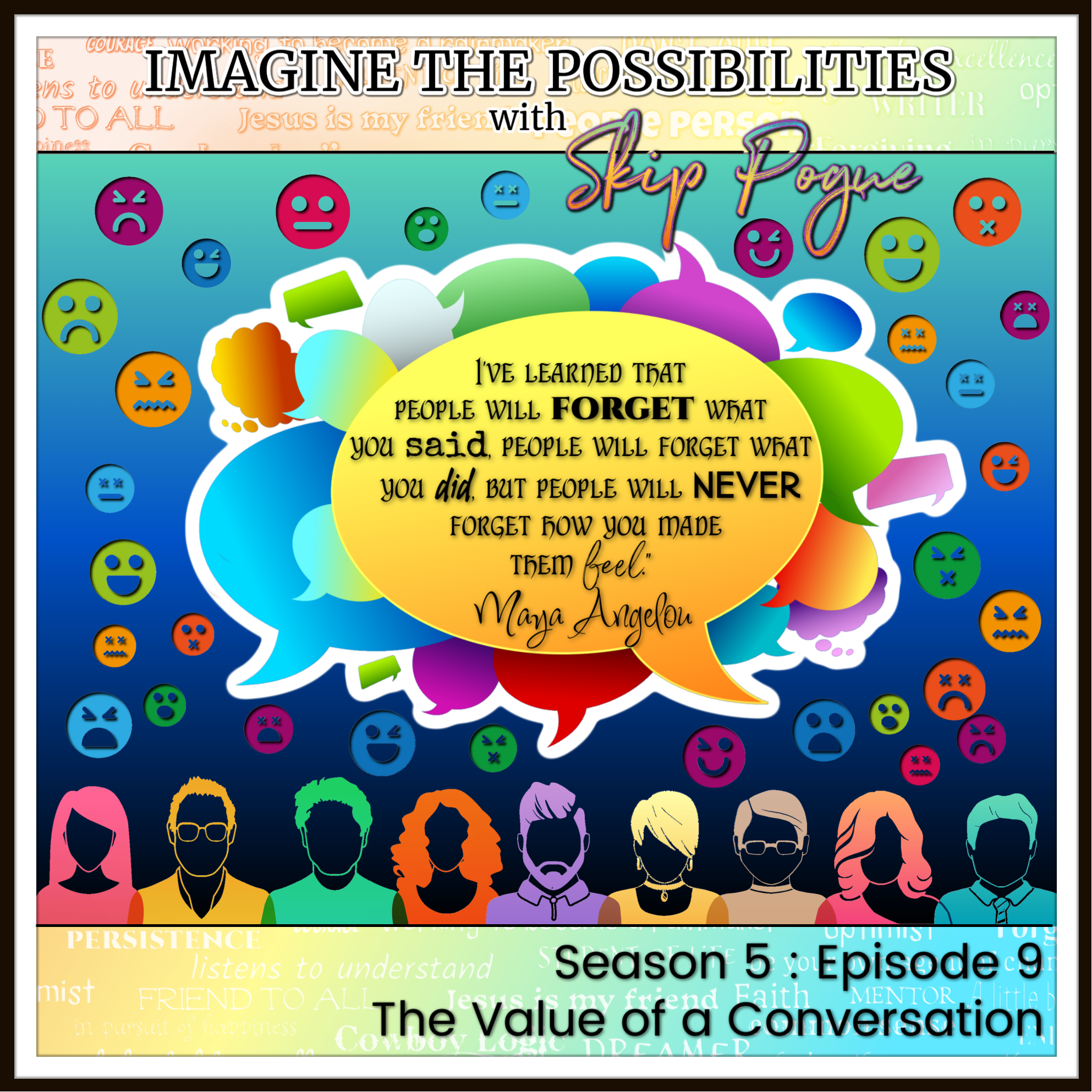
[00:14:45] It's about how people may not remember everything we say, but they'll always remember how we made them feel.
[00:14:57] I think there's something worth considering in that thought.
[00:15:01] When we finish a conversation, what do we want the other person to take away from it?
[00:15:09] Do we want them to remember that we were determined to prove we were right?
[00:15:15] Or would we rather them remember that we listened, that we considered what they had to say, and throughout that conversation, we treated them with respect?
[00:15:30] And what about us?
[00:15:32] What did we learn?
[00:15:35] Did we discover something new about the subject?
[00:15:39] Something about the other person?
[00:15:42] Or perhaps something about ourselves?
[00:15:46] Maybe that's a question worth asking after our next meaningful conversation.
[00:15:52] Not Did I win?
[00:15:56] Not even did we agree?
[00:15:59] But simply, what did I take away from that conversation?
[00:16:05] And perhaps we might want to ask ourselves one more question.
[00:16:11] How might what we learned help us in our next conversation?
[00:16:16] Because when we think about it, we never really stop learning how to have conversations.
[00:16:23] We continue developing those skills through our experiences with other people.
[00:16:30] And if we're willing to listen, consider, question and reflect, every conversation can help us grow, not just in what we know, but in how we understand one another and perhaps even how we understand ourselves.
[00:16:57] So maybe the next time we find ourselves at that fork in the road, we won't be quite as concerned about whether we're taking the same path.
[00:17:07] Perhaps we'll be more interested in what we've discovered on our journey.
[00:17:14] Because the value of a conversation isn't necessarily found in agreement.
[00:17:21] Sometimes it's found in understanding we take away from it.
[00:17:27] And maybe that's one more way we continue becoming who we're supposed to be.
[00:17:37] Until next time.
[00:17:39] Stay humble, be kind, love unconditionally, and laugh often.
[00:17:48] Remember that your future belongs to you.
[00:17:52] And never forget this.
[00:17:55] You're enough, you're worthy, and you're seen.
[00:18:04] As always, I wish you much success.
[00:18:08] Have a super day and may God bless you in a super way.
[00:18:14] Thanks again and God bless.