Episode Transcript
[00:00:03] One of the first experiences I remember happened when I was pretty young.
[00:00:11] My parents kept telling me not to touch the oven door.
[00:00:16] They'd tell me, it's hot, it'll burn.
[00:00:21] Now I understood the words hot and and burn, or at least I thought I did.
[00:00:32] But apparently I needed a little more information.
[00:00:36] I needed to experience it, to understand it.
[00:00:41] So I touched the oven door.
[00:00:45] And suddenly those two words meant something they hadn't meant a few seconds ago.
[00:00:52] I had experienced hot.
[00:00:55] I had experienced burn.
[00:00:58] And if I remember it correctly, I never touched that oven door again.
[00:01:08] My parents had told me exactly what would happen.
[00:01:13] They weren't wrong.
[00:01:15] I just had to experience it for myself.
[00:01:22] Maybe that's one of the interesting things about experience.
[00:01:27] Someone can tell us something.
[00:01:29] They can even go so far as explain it to us.
[00:01:34] They can even warn us about it.
[00:01:39] Sometimes there's a difference between knowing something because we've been told and understanding something because we've experienced it.
[00:01:51] How about you? Have you ever had something happen that made you suddenly understand what someone had been trying to tell you all along?
[00:02:03] When we hear the word experience, I think it's easy for us to think about all the experiences we've accumulated over the years.
[00:02:16] Now, if I wanted to tell someone about my professional experience, I could hand them my resume.
[00:02:27] Most resumes are really a record of experience.
[00:02:33] Companies we've worked for, responsibilities we've accepted, things we've accomplished and the value we've added.
[00:02:46] But I've come to believe that resumes tell only a small part of the story.
[00:02:54] The reason I believe that experience comes from far more places than simply employment.
[00:03:04] It comes from people we've known, things we've tried, things that worked, things that didn't work, conversations, faith, hobbies, reading, education, travel, observation, and simply ordinary everyday life.
[00:03:33] Some of those experiences probably didn't seem particularly important when they happened.
[00:03:44] Sometimes it isn't until much later that we begin to understand what we've learned from them.
[00:03:55] I spent years looking over people's resume.
[00:04:00] Some of our newer managers had been promoted from within the company, and they had very little experience interviewing candidates or making hiring decisions.
[00:04:12] So sometimes I would sit with them while they were interviewing a candidate.
[00:04:20] I let them conduct the interview, and if there's a question that hadn't been asked, something we really needed to know, I could ask that question in a curious way.
[00:04:33] Now, I never asked the question in a manner that made them look bad or caused them to feel inadequate, didn't want to do that, ask it simply as something I wanted to know and Understand?
[00:04:52] When you think about it now, there's something interesting about what was happening.
[00:04:58] The managers were gaining experience while they were evaluating someone else's experience.
[00:05:08] Like I said, I. I could sit beside them.
[00:05:12] I could listen to the questions they asked, I could ask something they missed.
[00:05:18] And afterward we could discuss the candidates and the interview.
[00:05:27] But here's the thing.
[00:05:30] I couldn't give them my years of interviewing and management experience.
[00:05:38] I could share what my experience had taught me, and perhaps I could use my experience to help them develop theirs.
[00:05:50] But they still had to experience it for themselves.
[00:05:55] And maybe that's true in a lot of other areas of our lives.
[00:06:02] We can learn from someone else's experience.
[00:06:09] We can listen to what they've learned, we can take their advice.
[00:06:16] But at some point, we have to take what we've been given and do something with it ourselves.
[00:06:29] I feel like there's an important distinction there.
[00:06:33] We can't give someone our experience, but we can share what our experience has taught us.
[00:06:43] Pretty simple.
[00:06:46] And the thing is, what we share may become part of someone else's experience.
[00:06:54] Now, not every experience we have is positive.
[00:07:02] Now, I've talked about failure before.
[00:07:08] Suppose we try something once and we fail.
[00:07:15] That experience might come cause us to simply say, I can't do that.
[00:07:22] But maybe, maybe that's not what the experience was actually telling us.
[00:07:32] Maybe it was telling us, I can't do it this way.
[00:07:37] Now, those are really two very different lessons, if you think about it. The first one can cause us to stop.
[00:07:48] The second one can cause us to ask questions.
[00:07:54] What can we learn from that failure?
[00:07:59] What can we change?
[00:08:02] What can we adjust?
[00:08:07] I truly don't believe every failure is telling us to stop.
[00:08:16] Sometimes I think it's just simply telling us that something needs to be changed before we try again.
[00:08:29] I think for us, that should raise another question.
[00:08:39] The question is, have we ever allowed one experience, one experience, to convince us that we couldn't do something?
[00:08:54] Maybe all it was really telling us was that we needed to try it differently.
[00:09:02] Think about that.
[00:09:04] Because I believe much of life may be an experience followed by an adjustment, followed by another experience.
[00:09:17] And those experiences, Some of us don't understand.
[00:09:31] At times I found myself wondering, do experiences need to be dramatic?
[00:09:43] I don't think so, because most of the time they're simply part of what happens through our ordinary lives.
[00:09:56] But there's something else I've come to appreciate about experience.
[00:10:04] There's times that we don't really understand what we've learned until we look at something from a different perspective.
[00:10:16] Now, one of the best lessons I ever learned about perspective came through photography.
[00:10:23] Now, when it comes to photography, I started with a Polaroid camera, but eventually moved into digital photography. And I had better equipment and interchangeable lenses.
[00:10:41] But better equipment wasn't the most important thing I learned.
[00:10:46] I took a photography class.
[00:10:49] The instructor told us to go out and find one subject, didn't matter what it was, take one picture and come back and let him look at that picture.
[00:11:03] I found a lone tree on a hillside, and I took the picture.
[00:11:11] Went back to the instructor, and he fired up his laptop, looked at it, and told me, that's a good picture, but it's not a great picture.
[00:11:23] Not the best picture you could have gotten.
[00:11:27] So I asked him, how could I make it better?
[00:11:33] His answer was pretty simple.
[00:11:36] Change your perspective.
[00:11:39] He told me to return to the same spot and take another photograph.
[00:11:44] Then move one step to the right, keeping the tree centered as the main focus, and take another picture.
[00:11:54] He told me to continue that for 10 steps and take a picture each time.
[00:12:03] Then he told me to return to the original position and do the same thing, moving to the left.
[00:12:11] I went back and did what he said.
[00:12:16] When I returned with the pictures, he began scrolling through them.
[00:12:23] And suddenly, as I was watching the pictures go by, one of them jumped out to me.
[00:12:29] It did him too, and he said, that's a great picture.
[00:12:37] He then asked me what I'd changed.
[00:12:41] It wasn't a different tree.
[00:12:44] It wasn't even a different camera.
[00:12:47] The important change wasn't shutter speed or focus.
[00:12:52] I'd simply changed my perspective.
[00:12:58] The thing is, I'd gone through that process myself.
[00:13:03] I didn't simply know what the instructor meant.
[00:13:07] I understood it.
[00:13:09] I had gained experience.
[00:13:13] I've remembered that lesson ever since it happened.
[00:13:20] And I've discovered that changing our perspective to can make a difference in a lot more than simply photography.
[00:13:29] How about you?
[00:13:32] Have you ever looked at the same situation from a different perspective and suddenly seen something you couldn't see before?
[00:13:46] When I think about that photography lesson and the oven door I touched when I was a little boy, I realized those experiences happened a decade apart.
[00:14:00] But maybe they aren't all that different.
[00:14:04] As a little boy, someone told me the oven was hot.
[00:14:09] I touched it, and I understood what hot really meant.
[00:14:17] Years later, when I took that photography class, the instructor told me to change my perspective.
[00:14:26] I moved and took photos and discovered what he meant.
[00:14:34] In both those situations, someone had given me information.
[00:14:39] But it was really the experience that changed my understanding.
[00:14:45] And perhaps that's something worth remembering.
[00:14:50] Having an experience and understanding an experience aren't necessarily the same thing.
[00:15:01] The fact is, we may have years of experience doing something, but does that automatically mean we've continued to learn and grow?
[00:15:18] Think about someone who's done the same job for 20 years.
[00:15:24] Do they have 20 years of growth and learning?
[00:15:29] Or could they have one year of experience repeated 19 times?
[00:15:38] Now, repetition isn't necessarily a bad thing.
[00:15:44] Sometimes repetition helps us become more proficient at whatever we're doing.
[00:15:53] But the thing I wonder about is if there's a difference between repeating an experience and learning something new from it.
[00:16:05] Maybe the difference has something to do with whether we're actually paying attention.
[00:16:13] Are we simply doing what we've always done?
[00:16:17] Or are we occasionally asking ourselves whether there's something we could understand better, something we could change, or maybe something we might do differently?
[00:16:32] Our experiences aren't limited to our jobs.
[00:16:36] They're happening every day now.
[00:16:41] Sometimes it's a big experience.
[00:16:46] Some of them may be grand.
[00:16:49] They may actually change the direction of our lives and we'll remember those experiences forever.
[00:17:01] But others may be so ordinary that if we're not paying attention, they simply ruffle our hair as they go by.
[00:17:14] The thing is that maybe those ordinary experiences are worth paying attention to as well as the big experiences.
[00:17:26] I'd like to ask you to do something.
[00:17:29] Take a few minutes and think about the last two or three experiences you've had.
[00:17:36] Now, they don't have to be big experiences or life changing moments.
[00:17:43] It could be something that happened at work, a conversation with someone, something you tried, something that didn't work, or simply something that happened during an ordinary day.
[00:18:07] Think about what one of those experiences taught you.
[00:18:13] Did it change the way you think?
[00:18:17] Did it change the way you see something?
[00:18:21] Is there something you might do differently the next time?
[00:18:26] And maybe most importantly, how can we use what we've learned from our experiences as we move forward toward becoming who we're intended to be?
[00:18:45] We have to remember that our experiences aren't simply a record of where we've been.
[00:18:53] They're part of what we carry with us as we move forward in our lives.
[00:19:00] They could change how we see where we are and what we choose to do with them can help shape who we're becoming.
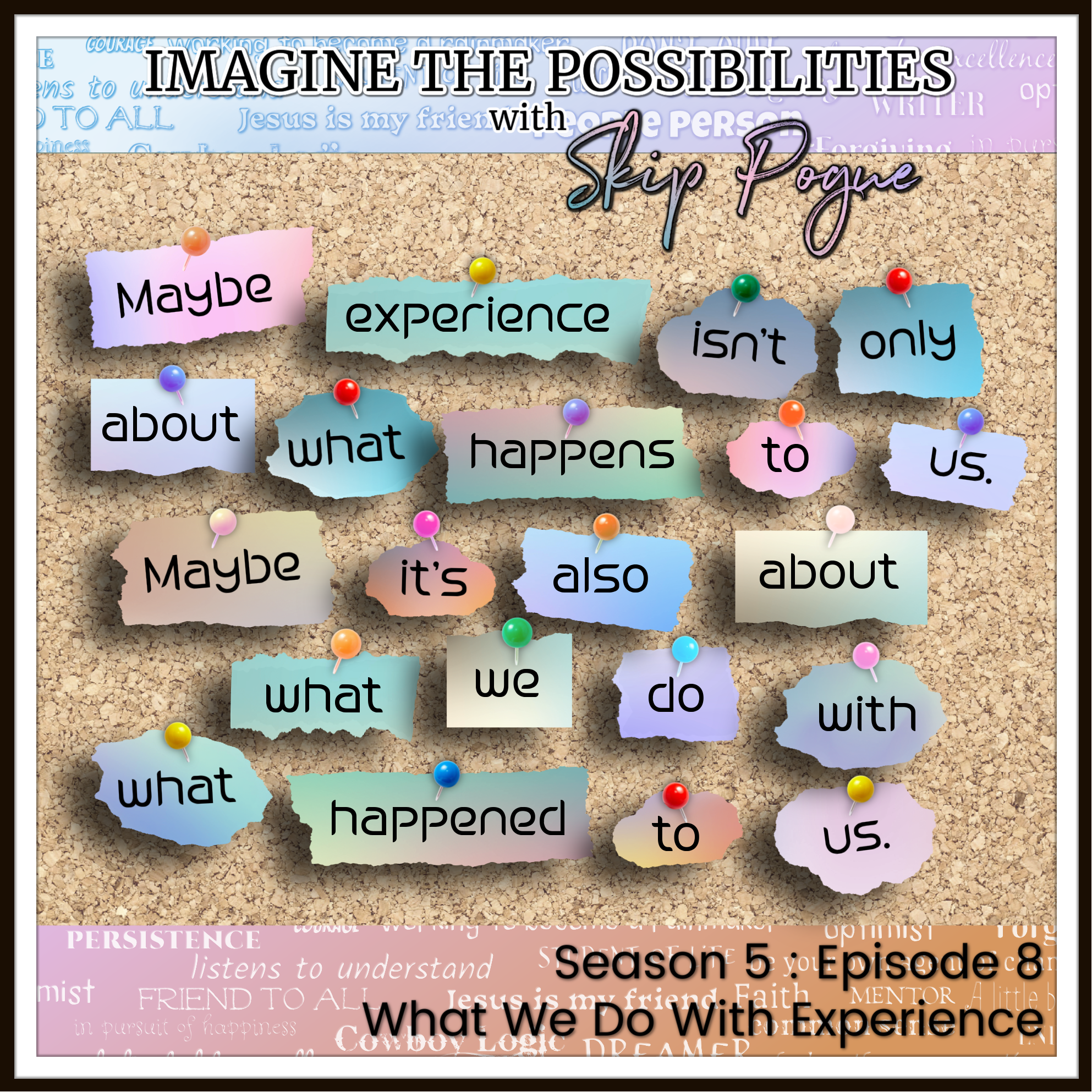
[00:19:14] Here's the thing. Maybe experience isn't only about what happened to us.
[00:19:20] Maybe it's also about what we do with what happened to us.
[00:19:26] Again, just something to think about.
[00:19:32] Before we finish today.
[00:19:34] Let me leave you with a thought.
[00:19:40] Every possibility we reach began with something we first imagined.
[00:19:48] And when imagination is joined by experience, desire and preferences.
[00:19:57] Possibilities have a way of becoming reality.
[00:20:04] Until next time, stay humble, be kind, love unconditionally and laugh often.
[00:20:13] Remember that your future belongs to you and never forget this.
[00:20:20] You are enough, you are worthy and you are seen as always. I wish you much success.
[00:20:33] Have a super day and may God bless you in a super way.
[00:20:41] Thanks again and God bless.