Episode Transcript
[00:00:06] Hello, friend, and welcome to Imagine the Possibilities.
[00:00:10] I'm really glad that you chose to join me today.
[00:00:14] I've been thinking about something which led me to this question.
[00:00:18] What am I worth?
[00:00:21] What are we worth?
[00:00:24] I'm not talking about how much money we have or what kind of car we drive or how big a house we own.
[00:00:31] It seems like we live in a world where value is being assigned all the time.
[00:00:38] Sometimes we see it and sometimes we don't.
[00:00:42] Our attention, our time, and our data, it all has value.
[00:00:52] And whether we realize it or not, we're being measured.
[00:00:58] Sometimes thought like this will lead me down a path.
[00:01:02] And if I'm not careful, that path can turn into a bit of a rabbit hole.
[00:01:08] So I try to follow it just enough to understand, but not so far that I lose where I started.
[00:01:19] This is one of those moments, because it turns out there's something called customer Lifetime value.
[00:01:28] CLV for short.
[00:01:30] It's the way companies try to understand what a person, what we might be worth over time.
[00:01:40] And when I read that, it made me stop and think.
[00:01:44] They're not just looking at what we buy today, but what we might buy tomorrow and next year and even beyond that.
[00:01:56] It's not personal, it's just business.
[00:02:00] In their world, our value can increase the more we spend, the more we engage, the more loyal we become.
[00:02:12] Now, I've seen all that play out in my own life.
[00:02:15] I'll give you a couple examples.
[00:02:17] The first one I want to talk about is Amazon.
[00:02:21] They're a bit different.
[00:02:23] And the thing is that Amazon uses a number of different ways to track us.
[00:02:29] Just think of all the data we give them.
[00:02:33] They know how much we buy, when we buy, what we're doing, what we're willing to spend on something.
[00:02:41] They've got it all and they don't have to pay anybody for it.
[00:02:46] It's already there.
[00:02:48] They use a thing called behavioral tracking. It's where they gather data on the clicks, the views, how long we hover over something.
[00:03:00] This is something I've had happen to me, and I'm pretty sure it's probably happened to you too.
[00:03:05] Have you ever looked at an item on Amazon and later you see an ad for that same item on a different website?
[00:03:15] Even with a picture and line that says click here for price, which takes you to an Amazon page featuring the product.
[00:03:25] I've done that several times. Clicked on here for price and off I go back to Amazon. That whole thing is called retargeting.
[00:03:35] There's also a thing called frequently bought together.
[00:03:39] And I really think they ought to rename it to Magic Encouragement.
[00:03:44] It uses algorithms to simply look at what items are usually purchased together and think about the data. Amazon has available millions and millions of purchases.
[00:03:57] So what they do is say, oh, this item you're going to put in your cart and this other item are usually purchased together. Would you like to do that?
[00:04:09] They just simply encourage us to buy both products and that's only a couple way Amazon uses our data to target us.
[00:04:20] I don't know how many more, but I can tell you it's a bunch of.
[00:04:26] Now, even after talking about all that, I have to admit that my family uses Amazon a lot.
[00:04:35] But the reason is simple. We live in a remote area, farms make up most of the businesses here and it takes about an hour to get to any big box store. And even when we get there, the choices may be limited.
[00:04:52] So over the years, Amazon's become our go to choice when we need something.
[00:04:58] Deliveries are still pretty quick. It's easy, don't have to leave my house.
[00:05:04] So Amazon it is.
[00:05:08] The second example I want to give you revolves around a company named Rode.
[00:05:15] When I did my first podcast, when I finally got up the nerve to turn the microphone on and record something, I was using a cheap mic and when I listened to sounded like it was recorded with a cheap mic, I thought of that adage, you get what you paid for.
[00:05:41] And I didn't release that podcast. It was that bad.
[00:05:47] Now I did what everybody does.
[00:05:51] I started researching microphones.
[00:05:55] The translation in that is I used Google to find out about mics that were used for podcasting.
[00:06:03] Every time I did a search for the top mics for podcasting, Rode came up.
[00:06:10] So I decided to try a Rode podmic.
[00:06:13] Now you have to remember I'm new to all this and really didn't understand what I was buying.
[00:06:20] But I felt like I was picking a winner.
[00:06:26] When it arrived, I noticed the quality of the packaging.
[00:06:31] It didn't shout quality, but you just knew it was there.
[00:06:37] I opened the package and took the mic out.
[00:06:40] I knew I had purchased a quality product.
[00:06:45] Now, like I said, I didn't understand what I was buying.
[00:06:50] And after reading all the information in the box, I realized that it didn't use USB connections.
[00:07:00] I couldn't connect it through USB directly to my computer.
[00:07:06] Seems it wasn't plug and play.
[00:07:11] The instructions said it connected using an XLR cable, so it was back to Google for me.
[00:07:21] I quickly discovered that I needed a mixer to connect it to and then the mixer would connect to my computer.
[00:07:33] So after I understood exactly what a mixer was and what it did.
[00:07:41] I went back to Amazon again.
[00:07:44] When I looked, it seemed that a mixer would cost anywhere from $50 to several thousand dollars. Pretty big range.
[00:07:53] I found out that Rode made a couple models.
[00:07:59] Once I found out the model I wanted and everything, I started discussing buying it with my wife.
[00:08:06] I told her how much it cost and everything, and she was okay with that.
[00:08:10] Then she said something about my birthday coming up and she said she'd been trying to figure out what to get me.
[00:08:20] She then told me to order it and she would pay for it.
[00:08:25] Asked her if she was sure knowing what it cost, and she replied yes.
[00:08:32] So, like a good husband, I ordered one.
[00:08:37] Like the Podmic, I ordered it directly from Rhode.
[00:08:43] Thing is, it didn't stop with those two items because I now trusted the brand and I ordered another product and then another, and before I knew it, I had five of their products.
[00:09:00] Now, there's one other reason I like Rode.
[00:09:03] They don't bug me with emails.
[00:09:06] Some companies I do business with seem like I get an email from them every day with the same information, just worded differently.
[00:09:16] The fact is that with Rode, I only get emails when a new product comes out or when there's an update available for one of the products I have.
[00:09:28] I guess the relationship I have with Rode was really built on quality, trust and loyalty.
[00:09:38] I said all that. Say this, those kind of measurements work in business.
[00:09:45] The thing is, like Amazon, many businesses are all about transactions and outcomes.
[00:09:54] When we start applying the same kind of thinking to ourselves, things tend to get a little blurry.
[00:10:04] But that's not the only place we see this. There's another place where it shows up, and that's at our work.
[00:10:14] We might look around and realize we're making $20 an hour and someone else is doing the exact same job and they're making 25.
[00:10:26] And whether we say it out loud or not, there's a question that starts forming in the background.
[00:10:34] Are they worth more?
[00:10:38] Am I worth less?
[00:10:41] And that's not always an easy question to reconcile.
[00:10:47] Now, I think part of us always understands that there could be a lot of reasons for the difference, but another part of us feels and takes it personally.
[00:11:03] Now, I remember a time when this really hit home for me.
[00:11:09] I was working as a marketing program manager, and one day a colleague and I were having a conversation about our jobs, and somehow our salaries came up.
[00:11:24] He had a pretty good idea of what I was making.
[00:11:28] He told me what I was making, and he was actually really close.
[00:11:33] And then he told me what he was making.
[00:11:38] My first thought was, am I not worth as much as he is now? Thankfully, that thought only hit me for a moment, but then I kind of stepped back and started looking at it differently.
[00:12:00] He and I had taken completely different paths to get to the same job.
[00:12:07] He'd been a branch manager, and I had come up through the ranks, so to speak. I was never a manager.
[00:12:17] And the more I thought about it, the more it made sense.
[00:12:21] They wanted him to do the job because of his background and his work that he had done.
[00:12:29] And no matter how much he wanted the job, he wasn't going to take a pay cut to accept it.
[00:12:38] And I truly understood that.
[00:12:41] Different paths, different salaries.
[00:12:45] Now, once I saw it that way, something shifted for me.
[00:12:50] Instead of comparing my self worth to his, I decided that I was going to learn from him.
[00:13:00] I was going to learn everything I could from Jim.
[00:13:06] I paid attention, I asked questions.
[00:13:10] I grew up.
[00:13:12] And over time, that gap started to close.
[00:13:18] But here's the important part of all that.
[00:13:21] I never base my self worth on what I made.
[00:13:26] And that's the danger of tying our worth to numbers.
[00:13:33] Sooner or later, we're going to begin to question our value.
[00:13:40] And if we're being honest, if we're being honest with ourselves, we know there are moments when we don't feel like we are.
[00:13:51] That our value's not what we think it should be, even if the facts show that it really is.
[00:14:02] I found myself wondering why. What it would look like if we tried to measure ourselves the way we measure everything else.
[00:14:12] And the more I thought about it, the more it didn't sit right with me.
[00:14:17] Because the moment we try to measure something that was never meant to be measured, we risk missing its true value.
[00:14:31] And that thought led me to something I didn't expect.
[00:14:36] I'm going to share something personal here.
[00:14:40] I'm currently taking medication that costs more than I ever imagined something like that could cost.
[00:14:49] And I found myself thinking about that.
[00:14:53] Not necessarily in a negative way, but more in a reflective way.
[00:15:00] And a question came to mind.
[00:15:03] Am I worth it?
[00:15:06] And for me, the answer is yes.
[00:15:10] And I don't think no. I know that I'm not the only one that would feel that way.
[00:15:18] Because maybe our worth isn't something that gets decided by numbers.
[00:15:25] Maybe it's something that we were never meant to measure in the first place.
[00:15:32] We spend so much time measuring ourselves by what we've done, by what we haven't done.
[00:15:39] How many times we fail, how many times we succeed, how many times we don't accomplish what we set out to do and how we compare to others.
[00:15:52] The sad part is that sometimes we let those measurements define us.
[00:16:01] But just because something can be measured doesn't mean that's where its value comes from.
[00:16:10] And just because someone else doesn't see our worth doesn't mean it's not there.
[00:16:19] For me. I've come to believe that our worth isn't something we earn.
[00:16:25] It's something that already exists.
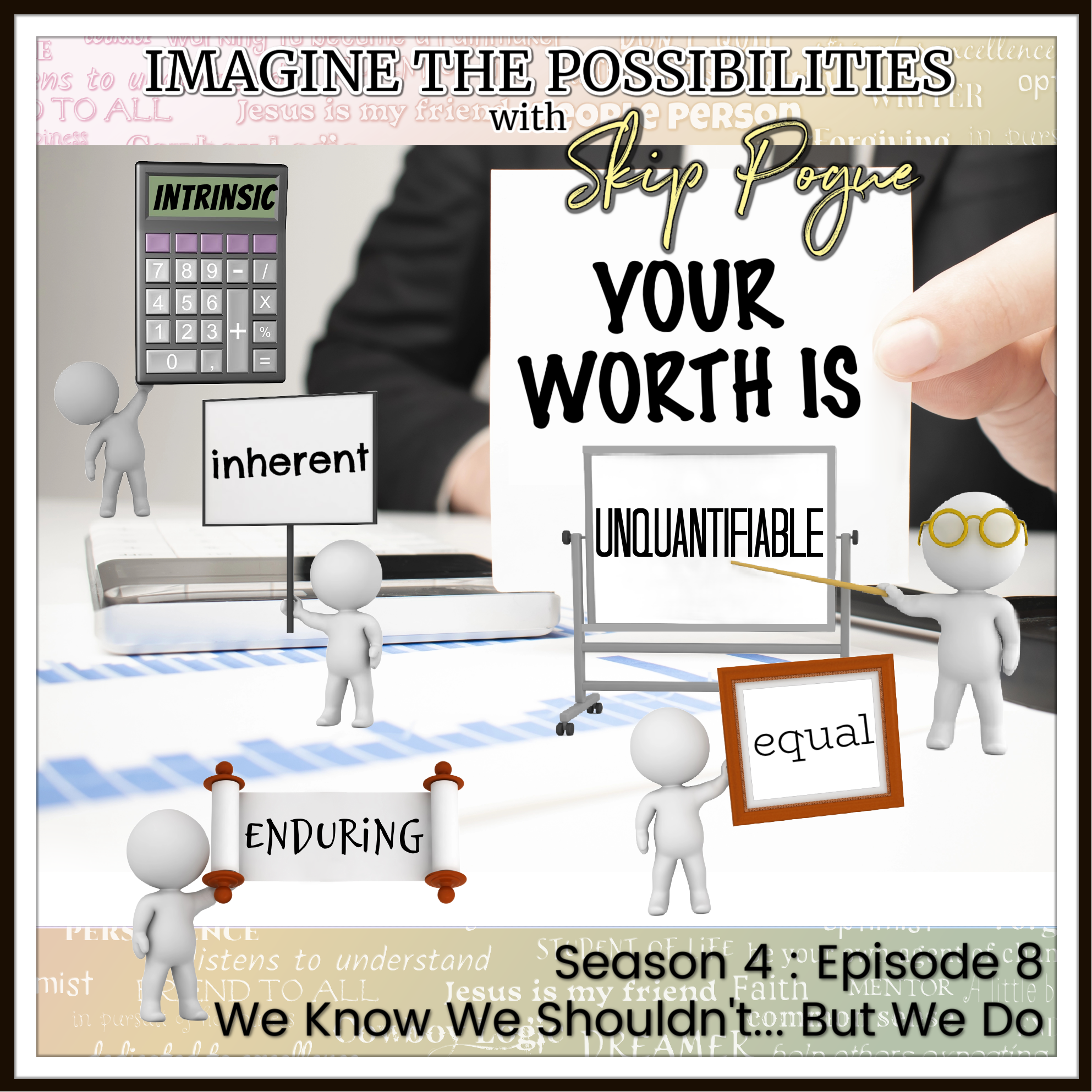
[00:16:29] Maybe the real question isn't what are we worth?
[00:16:34] Maybe the real question is when will we start believing that we are.
[00:16:41] Maybe that's just something to think about today. If you ask me to describe my worth in just a few words, I believe the following five words best describes my worth.
[00:16:56] I also believe they describe your worth.
[00:17:02] Inherent, intrinsic, enduring, equal, and unquantifiable.
[00:17:14] That's who we are.
[00:17:17] Maybe it's who we've been all along.
[00:17:21] Until next time, stay humble, be kind, love unconditionally, and laugh often.
[00:17:32] Remember that your future belongs to you.
[00:17:36] And never forget this.
[00:17:38] You are enough.
[00:17:40] You are worthy, and you are seen.
[00:17:46] And I know that you can accomplish remarkable things.
[00:17:52] So do you.
[00:17:54] As always, I wish you much success.
[00:17:58] Have a super day and and may God bless you in a super way.
[00:18:06] Thanks again and God bless.