Episode Transcript
[00:00:13] Hello, friend. Skip here. And I'd like to welcome you to imagine the possibilities.
[00:00:19] I've got to say something. I really appreciate that you choose to join me when you do.
[00:00:25] Thanks.
[00:00:27] I've been thinking about something lately.
[00:00:30] It feels like we're living in a time where a couple things just don't quite add up.
[00:00:37] On one hand, we have more information available than ever before.
[00:00:43] It's everywhere and it's right at our fingertips all the time.
[00:00:49] But on the other hand, understanding feels harder to find.
[00:00:55] It's like we're seeing two things that should go information and understanding. But instead of working together, they almost feel like they're pulling apart.
[00:01:08] I guess you could say we're surrounded by information, but we're still searching for understanding.
[00:01:16] I guess it's like the more we learn, the more we realize how little we know.
[00:01:23] When I first said those words, they sounded a little strange.
[00:01:28] But when I sat with them a moment, I realized there's truth there.
[00:01:34] And that's what I want to talk about today.
[00:01:37] Not just information, but understanding.
[00:01:41] Now, information can fill our minds.
[00:01:45] But understanding shapes how we think, how we decide, and how we choose to live.
[00:01:53] When we look at the world we're living in, we realize that that world is overflowing with information.
[00:02:01] And despite having access to almost all of it, understanding can still feel like it's just out of reach.
[00:02:10] Information fills the mind, but understanding goes deeper.
[00:02:16] It brings context, meaning, wisdom, and discernment.
[00:02:25] Understanding helps us decide what truly matters.
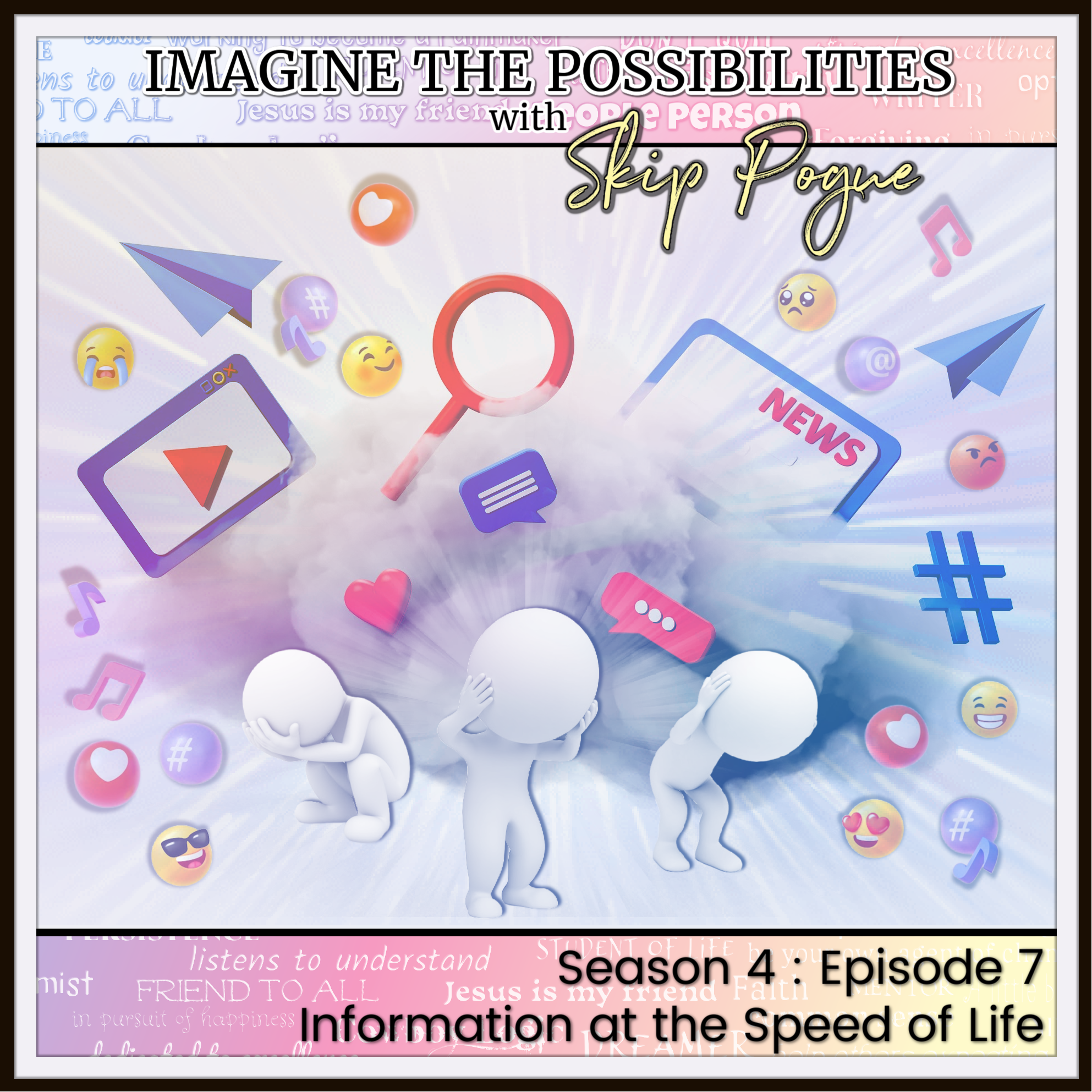
[00:02:30] Life at the speed of information, we're surrounded by constant news cycle, endless feeds, and a steady stream of opinion.
[00:02:42] And when it comes to opinions, a lot of those are very emotional.
[00:02:47] The real challenge today isn't the access to the information.
[00:02:51] It's learning how to process it. Learning how to process it wisely.
[00:02:56] Because understanding doesn't come from volume. It comes from reflection.
[00:03:03] And reflection requires something we don't always give ourselves space.
[00:03:11] Information is everywhere. Search engines, social media, notifications, Gmail, this and that.
[00:03:18] We can get instant answers to almost anything we want to know.
[00:03:22] Type in the question, get the answer.
[00:03:26] But instant answers don't.
[00:03:29] They don't always lead to thoughtful conclusions.
[00:03:32] Information tells us what, but understanding? Ask the why, the how, and what does that mean for me?
[00:03:43] Information gives us content.
[00:03:46] Understanding gives us direction.
[00:03:50] Here's one thing we need to understand.
[00:03:53] All information isn't created equally.
[00:03:58] Some of it's accurate, some of it's incomplete, and some of it's shaped by someone else's perspective.
[00:04:07] And that matters, because how something is presented can influence how we think about it, how we interpret it, what's highlighted, what's minimized, what's left unsaid.
[00:04:23] In a previous podcast, I talked about creating Excel spreadsheets with all the data in them for the executives of the company.
[00:04:31] And I alluded to the fact that I can take an Excel spreadsheet and I can put numbers in it that'll show we're doing great, or that I can present them in a way that shows we're not doing great, or I can show we're just running the middle of the road.
[00:04:49] Now, if I can do that with Excel, think what people can do with words.
[00:04:56] We see this in the news, how the news is presented today.
[00:05:02] One day, I found myself watching, or listening, I guess, to different sources on the same topic.
[00:05:09] And it felt like I was listening to two competing teams.
[00:05:14] Each of them were trying to get me to join their team.
[00:05:19] And I caught myself thinking the truth probably lies somewhere in the middle.
[00:05:25] And I think it does.
[00:05:28] The thing is, I don't really need someone telling me what to think.
[00:05:33] The only real teller I need is the one at my bank.
[00:05:39] What I really need is. Is space to step back, space to think for myself and the ability to decide what all this means.
[00:05:54] Understanding requires discernment, and discernment requires something simple but powerful.
[00:06:03] A pause before we react, before we share, and before we decide when we're flooded with information, it can take its toll.
[00:06:18] It can actually reduce clarity.
[00:06:21] It can increase how we react to something emotionally.
[00:06:28] And it can crowd out reflection.
[00:06:32] Knowing more doesn't always mean feeling more grounded.
[00:06:38] Sometimes I think the most responsible thing we can do is slow the information down.
[00:06:46] I'll give you an example.
[00:06:48] I've been doing podcasts where I need to research something online.
[00:06:54] Maybe it's about something specific. And I want to make sure that what I know and what's. I guess you could say factual, it matches, it's right.
[00:07:08] I've had moments where I'm researching something online, and I end up with tab after tab after tab open.
[00:07:16] Now, each one has information, and each one more than likely adds something to what I'm trying to understand.
[00:07:24] But instead of feeling more informed, I start feeling overwhelmed.
[00:07:31] Almost like I'm stuck.
[00:07:34] This happened not too long ago, and I realized that I had over 20 tabs open.
[00:07:43] I also realized that I was overwhelmed.
[00:07:47] Now, I knew they had information, but I don't think brain fog is the right word. It's when you're overwhelmed by information.
[00:07:55] And I was. So I did what anybody I think would do. I closed them, all of them.
[00:08:04] And I stepped away for a bit.
[00:08:07] I went in the kitchen, fixed myself a glass of sweet iced tea.
[00:08:13] I'm from the south and I love sweet iced tea. And I went and sat at the picnic table outside on a patio.
[00:08:20] And as I was reflecting on what happened, I realized something.
[00:08:26] The information wasn't the problem.
[00:08:30] The understanding was.
[00:08:32] And understanding needs space to catch up.
[00:08:37] We can read all this stuff we've got access to, but just reading it doesn't give us understanding. And it takes understanding longer than it does to look at the information itself for us to understand.
[00:08:54] All this reminds me of something I talked about in an earlier episode on communication, the way we listen to people.
[00:09:04] This mirrors the way we process information.
[00:09:08] Are we listening to understand?
[00:09:11] Are or are we listening to react?
[00:09:15] The same question applies here.
[00:09:18] Understanding takes time. Understanding rarely shows up instantly. It grows over time.
[00:09:25] When information's had a chance to settle, when emotions have calmed down, and when perspective has space to form.
[00:09:38] Some things don't need speed, they need time.
[00:09:43] Information arrives quickly.
[00:09:47] Understanding unfolds slowly.
[00:09:51] How do we live wisely in an information saturated world?
[00:09:56] What do we do with all this?
[00:09:59] Maybe it starts with a simple shift.
[00:10:03] We don't necessarily need more information.
[00:10:07] What we in all likelihood need is more reflection.
[00:10:12] We're not ignoring the world, we're choosing quality over quantity.
[00:10:19] The thing is that if we take the time for reflection, it doesn't give us more answers, but it helps us find better answers.
[00:10:32] Practical discernment questions.
[00:10:35] Before reacting, sharing or deciding, maybe we should pause and ask ourselves what's true, what's missing, and why does this matter?
[00:10:54] I feel like by doing that, we create space for information to become understanding.
[00:11:01] That simple. Let me leave you with this.
[00:11:05] What one area of our lives where more reflection, not more information, might bring us greater clarity.
[00:11:15] You don't have to answer it right away.
[00:11:18] Just think about it, reflect on it.
[00:11:22] I think we can all agree that we don't lack information.
[00:11:27] What we often lack is space.
[00:11:32] Information can fill a mind, but understanding can guide a life.
[00:11:39] And when we give ourselves the space to reflect, we give understanding a chance to catch up.
[00:11:48] And maybe, just maybe, what we really need isn't more information, but information at the speed of life.
[00:12:00] Until next time, stay humble, be kind, love unconditionally, and laugh often.
[00:12:09] Remember that your future belongs to you.
[00:12:12] And never forget this.
[00:12:14] You are enough, you are worthy, and you are seen.
[00:12:22] And I truly believe that you're destined to accomplish remarkable things.
[00:12:28] I wish you much success.
[00:12:31] Have a super day and may God bless you.
[00:12:35] Thanks again, Sam.