Episode Transcript
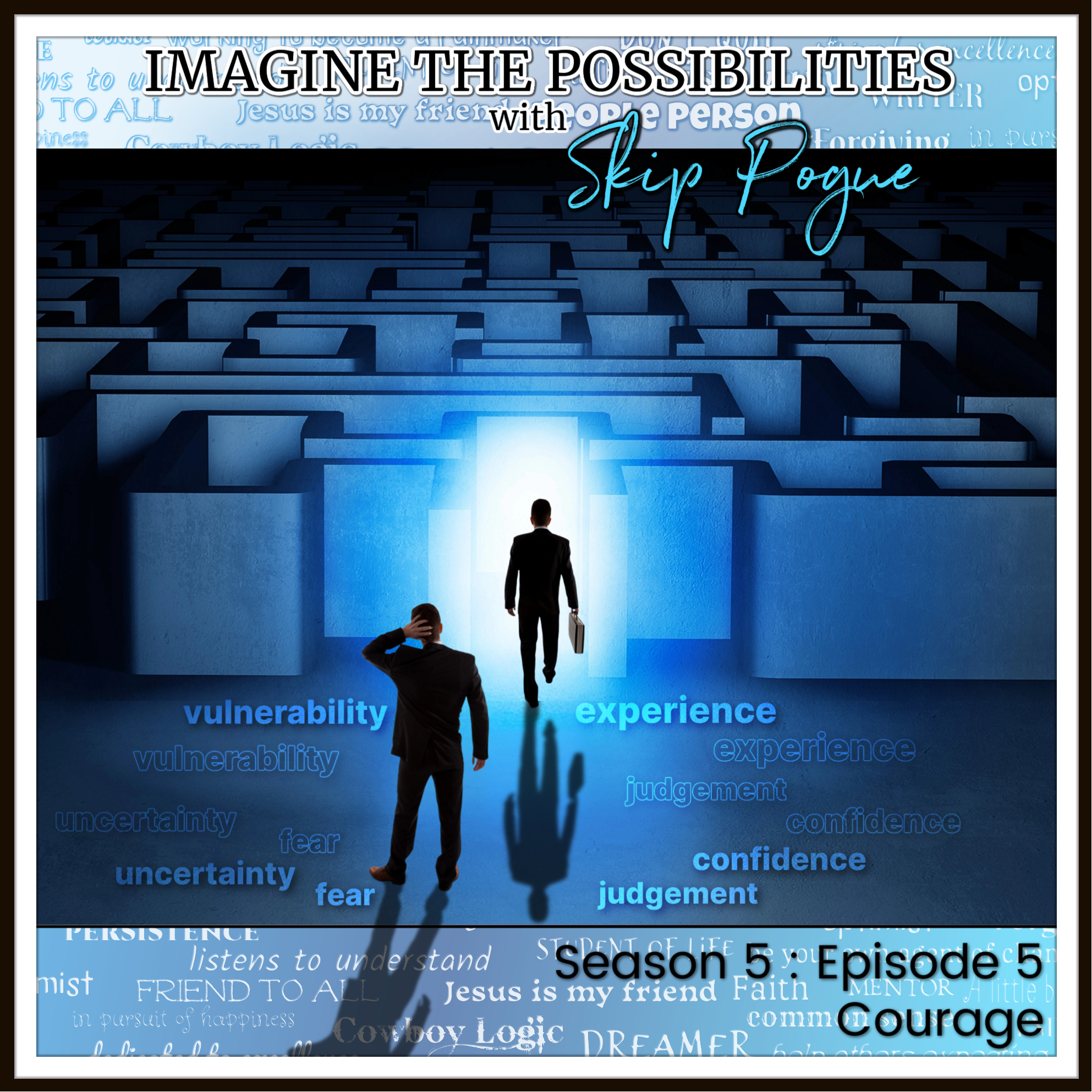
[00:00:02] What do you think about when you hear the word courage?
[00:00:07] For me, when I hear the word courage, I picture things like a firefighter running into a burning building, or a soldier in battle, or someone risking their own safety to save another person.
[00:00:27] I think all these are easy for us to recognize as acts of courage.
[00:00:34] But I've started wondering if thinking about courage in that way causes us to miss something.
[00:00:43] We tend to recognize courage when it's extraordinary, but many times we overlook courage when it's ordinary, starting something when we don't know whether we'll succeed.
[00:00:58] Standing up in a meeting and disagreeing with everyone else, admitting we made a mistake, stepping out of our comfort zone, walking away from something we know is wrong, having a difficult conversation that we've been avoiding, or turning on a microphone and recording your first podcast.
[00:01:27] None of those seems to compare with the examples we started with.
[00:01:32] But that's really not the point.
[00:01:36] When I think about courage, I see it as something we face as individuals.
[00:01:43] What requires tremendous courage from one person may require very little from someone else.
[00:01:51] And thinking about that's led me to believe something.
[00:01:55] Courage isn't determined by the action.
[00:01:59] It's determined by what the action requires of us.
[00:02:04] Now think about that for a minute.
[00:02:07] Two people could do the same thing, and it might require tremendous courage from one and little or no courage from the other.
[00:02:18] Someone might walk confidently into a room filled with strangers without giving it a second thought.
[00:02:26] For someone else, walking through that same door could require every ounce of courage they have.
[00:02:34] The room's the same, the people are the same, the action's the same.
[00:02:43] But the experience isn't.
[00:02:46] And I believe that means courage is far more personal than we sometimes realize.
[00:02:55] We see what another person does.
[00:02:59] We don't always see what it requires of them to do that.
[00:03:05] And I've come to realize something else.
[00:03:09] Even for the same person, what an action requires can change.
[00:03:17] Years ago, I attended a class that revolved around speaking to groups of people.
[00:03:23] At the beginning of the class, we were told to choose something we knew about and enjoyed and use that for the subject of our presentations.
[00:03:34] I chose photography.
[00:03:37] Every presentation we gave was recorded.
[00:03:41] Then we watched the recording, and the instructors and all the other people in the class critiqued what we'd done.
[00:03:52] Knowing that was going to happen certainly affected my level of fear.
[00:03:58] That week, I had to give the same presentation three times Monday, Wednesday, and Friday.
[00:04:07] On Monday, standing in front of that class and that camera required a lot of courage from me.
[00:04:15] On Wednesday, I did it again, but this time I had Monday's experience behind me, and I could feel that it required less courage.
[00:04:27] Then came Friday.
[00:04:29] I was amazed by the difference.
[00:04:33] I was relaxed in front of the camera and the class.
[00:04:37] Now the class hadn't changed, the camera hadn't changed, and my presentation hadn't really changed, but I had.
[00:04:50] Perhaps the action that once required courage became comfortable through experience.
[00:04:58] That class helped me often in later life.
[00:05:03] I participated in panel discussions, roundtable, did business shows, and had other situations where I had to speak in front of people or step in front of a camera.
[00:05:16] Because of that earlier experience, I could approach those situations relaxed and without the fear I'd experienced before.
[00:05:26] Part of growth is reaching the point where something that once required courage simply doesn't require it anymore.
[00:05:37] Not because the situation's changed, but because we've changed in relationship to it.
[00:05:45] Each time we find the courage to do something, we gain experience, and that experience can expand what we're capable of doing.
[00:05:57] But that raises another question.
[00:06:00] What makes something an act of courage?
[00:06:05] Maybe judgment has something to do with it.
[00:06:09] Two people could face the same situation and make completely different decisions.
[00:06:16] One might stay, the other might leave, and both decisions could require courage.
[00:06:26] Maybe that's because courage isn't always about moving forward.
[00:06:32] Sometimes courage means stopping.
[00:06:36] Sometimes it means speaking.
[00:06:40] Sometimes it means staying silent.
[00:06:44] Sometimes it means standing our ground.
[00:06:48] And sometimes it means walking away.
[00:06:53] Risk by itself isn't courage.
[00:06:56] Doing something we believe is dangerous doesn't necessarily make us courageous.
[00:07:03] Sometimes doing something dangerous is just doing something foolish.
[00:07:09] And refusing to do something isn't necessarily cowardice.
[00:07:15] Sometimes saying no requires far more courage than saying yes.
[00:07:20] Courage and judgment have to work together.
[00:07:25] We're human beings, and sometimes our first response to a situation happens before we've had time to think about it.
[00:07:34] But fear isn't necessarily the enemy of courage.
[00:07:39] Fear can contain useful information.
[00:07:43] Experience can tell us I've been here before.
[00:07:48] Judgment helps us consider the circumstances.
[00:07:53] Our values help us determine what matters.
[00:07:58] But none of those can make a decision for us.
[00:08:02] We've got to do that ourselves.
[00:08:06] That's where courage enters the picture.
[00:08:10] Courage may be what allows us to do what we believe we should do, even when doing so requires something of us.
[00:08:20] Courage doesn't necessarily eliminate fear or our instinctive response.
[00:08:28] It gives us a way to act in the presence of it.
[00:08:33] Now, that doesn't mean we always make the right decisions.
[00:08:38] We won't.
[00:08:39] We're human.
[00:08:41] We make decisions based on what we know and understand at the time.
[00:08:48] But courage may be what allows us to make the decisions we believe are right.
[00:08:53] Even when we know there could be consequences.
[00:08:58] A person can be terrified and still act courageously.
[00:09:03] In fact, sometimes fear may be the very thing that causes us to act.
[00:09:09] Imagine someone we love is in danger.
[00:09:13] We may be frightened beyond anything we've ever experienced, but the fear of losing that person may be greater than the fear of what could happen to us.
[00:09:24] So we act.
[00:09:27] Not because the fear disappeared.
[00:09:30] We act while we're afraid.
[00:09:33] And I don't always think courage requires fear.
[00:09:38] Sometimes what we're facing isn't frightening.
[00:09:41] It's simply uncertain.
[00:09:45] When I started imagining the possibilities, I wasn't facing physical danger.
[00:09:51] I wasn't preparing to do anything heroic.
[00:09:56] I was simply starting a podcast.
[00:10:00] But I didn't know what I was doing.
[00:10:03] I didn't know whether anyone would listen.
[00:10:07] I didn't know if I would be any good at it.
[00:10:11] I knew there would be challenges, and there were.
[00:10:16] There came a point when all the thinking and planning I'd done had to come to an end.
[00:10:23] I had to turn everything on, sit down in front of the microphone, and record my first podcast.
[00:10:33] Was that courage?
[00:10:36] I think it was not, because recording a podcast is courageous.
[00:10:42] For some people, it's incredibly easy, but it requires something from me.
[00:10:50] And that's why comparing our courage to someone else doesn't make sense.
[00:10:56] We see what another person does, but we don't always see what's required of them.
[00:11:06] We don't see the fear they had to overcome the uncertainty they had to accept, the vulnerability they had to expose the consequences they were willing to face or the sacrifices they were willing to make.
[00:11:27] Sometimes we don't recognize courage in other people because we don't know what it costs them to take the next step.
[00:11:36] And sometimes we fail to recognize courage in ourselves because we look at the action and think it wasn't anything special.
[00:11:47] But maybe we're looking at the wrong thing.
[00:11:52] Maybe the question isn't how extraordinary the action was.
[00:11:57] Maybe the question is what the action required of us.
[00:12:03] Maybe there's been moments in our lives when we demonstrated courage without ever calling it courage.
[00:12:13] We started over when starting over seemed impossible.
[00:12:18] We admitted we were wrong.
[00:12:21] We asked someone for help.
[00:12:25] We stood up for something we believed was right.
[00:12:29] We walked away from something we knew was wrong.
[00:12:34] We said yes when saying no would have been easier.
[00:12:39] Or we actually found the courage to say no.
[00:12:44] Those moments won't make the evening news.
[00:12:48] Nobody's going to write a book about them.
[00:12:51] But that doesn't mean they didn't require courage.
[00:12:56] We have to remember courage isn't reserved for extraordinary circumstances.
[00:13:03] It can be found in the ordinary moments of our lives.
[00:13:07] And when we find that courage, we may discover something about ourselves.
[00:13:14] We're capable of more than we thought we were.
[00:13:19] The situation may not have changed, but we have.
[00:13:25] And the question isn't simply, am I courageous?
[00:13:32] A better question is, what is life asking of me right now?
[00:13:38] And do I have the courage to respond?
[00:13:43] Fear may have something to say.
[00:13:46] Experience may have something to say.
[00:13:50] Judgment may have something to say.
[00:13:53] Our values may have something to say.
[00:13:56] But ultimately, the decision belongs to us.
[00:14:00] We choose because courage isn't determined by action.
[00:14:07] It's determined by what the action requires of us.
[00:14:12] And finding the courage to respond is another part of of becoming who we're meant to be.
[00:14:21] So maybe this week, walk into that room because you know you belong there.
[00:14:28] Take the next step, even if you don't know where it's going to lead.
[00:14:34] Have that hard conversation because it needs to be done.
[00:14:40] Do the things you need to do because you're ready.
[00:14:46] Until next time, stay humble, be kind, love unconditionally, and laugh often.
[00:14:56] Remember that your future belongs to you.
[00:14:59] And never forget this.
[00:15:01] You are enough, you are worthy, and you are seen.
[00:15:09] And always start your day with imagining possibilities.
[00:15:16] As always, I wish you much success.
[00:15:19] Have a super day and may God bless you in a super way.
[00:15:26] Thanks again and God bless.